The Primary Text: Romans 8:29-30
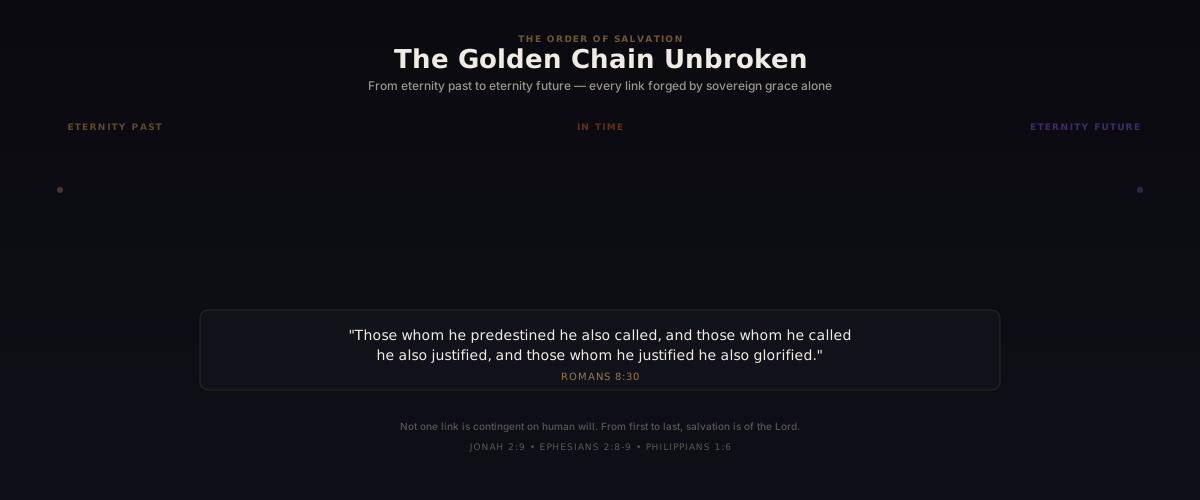
The Ordo Salutis is most concisely stated in Romans 8:29-30, where Paul presents the order of salvation in what the Reformed theologians call "the Golden Chain" — an unbreakable sequence from God's foreknowledge through final glorification.
"For those whom he foreknew he also predestined to be conformed to the image of his Son, in order that he might be the firstborn among many brothers. And those whom he predestined he also called, and those whom he called he also justified, and those whom he justified he also glorified."
— Romans 8:29-30 (ESV)
This one sentence encapsulates the entire ordo salutis: foreknew → predestined → called → justified → glorified. Notice the structure. It is a logical chain where each link presupposes the previous one and leads necessarily to the next. And crucially, notice that the same group moves through every stage. Those whom He foreknew are also predestined. Those predestined are also called. Those called are also justified. Those justified are also glorified. Not one person drops out. Not one link in the chain fails.
The secondary text is Ephesians 1:3-14, which expands the ordo salutis to include adoption, redemption, the sealing of the Holy Spirit, and the guarantee of future inheritance.
"Blessed be the God and Father of our Lord Jesus Christ, who has blessed us in Christ with every spiritual blessing in the heavenly places, even as he chose us in him before the foundation of the world, that we should be holy and blameless before him. In love he predestined us for adoption as sons through Jesus Christ, according to the purpose of his will... In him we have redemption through his blood, the forgiveness of our trespasses, according to the riches of his grace... In him you also, when you heard the word of truth, the gospel of your salvation, and believed in him, were sealed with the promised Holy Spirit, who is the guarantee of our inheritance until we acquire possession of it, to the praise of his glory."
— Ephesians 1:3-14 (ESV, selections)
Ephesians enriches the picture: chosen before the foundation of the world (eternal election), predestined for adoption (relational status), redemption through blood (forensic justification), sealed by the Spirit (assurance), guaranteed inheritance (perseverance and glorification). The ordo salutis is not a mere logical sequence; it is a love story written in the councils of God before time began.
What Is the Ordo Salutis?
The term Ordo Salutis comes from Latin: ordo (order) and salutis (of salvation). It refers to the logical sequence of the steps or acts by which God brings a person from spiritual death to eternal life. It is the "how" of salvation—the order in which the various operations and experiences of salvation occur.
Ordo Salutis vs. Historia Salutis
It is crucial to distinguish the Ordo Salutis (the order of salvation in individual experience) from the Historia Salutis (the history of salvation in the sweep of redemptive history). The historia salutis moves through creation, fall, promise, incarnation, atonement, resurrection, ascension, Pentecost, and the consummation. It is chronological and cosmic. The ordo salutis, by contrast, concerns the logical sequence of operations by which a single person is saved. It is the chain of grace applied to an individual soul.
While the historia salutis unfolds over ages, the ordo salutis may occur within a moment. A person who has been spiritually dead for forty years may be regenerated, justified, and adopted in the instant of conversion. But logically, regeneration (new birth) precedes faith (believing). Logically, justification (being declared righteous) precedes sanctification (becoming righteous). The ordo salutis is about logical priority, not always temporal sequence.
Reformed vs. Arminian Ordering
Different traditions order the steps of salvation differently. The Arminian ordering places prevenient grace first, then faith and repentance (as human responses), then regeneration (God's response to faith), then justification and sanctification. In this order, faith precedes regeneration. The person is partially restored by prevenient grace, exercises faith, and God responds by regenerating them.
The Reformed ordering, by contrast, places regeneration before faith. God regenerates (gives new life) first; the spiritually dead are made alive; and as a result of being alive, they believe. This order flows from the doctrine of total depravity: if a person is dead in sin, they cannot believe without first being made alive. The dead must be quickened before they can respond. Thus the Reformed order: Election → Predestination → Effectual Calling → Regeneration → Faith & Repentance → Justification → Adoption → Sanctification → Perseverance → Glorification.
Why does this matter? Because it determines whether salvation ultimately rests on divine grace or human choice. In the Arminian order, faith is a human act that precedes God's response. In the Reformed order, all of it—from beginning to end—is God's act. Even faith is given by God (Ephesians 2:8-9, Philippians 1:29, 2 Timothy 2:25).
The Links of the Chain: Step by Step
1. Election
Ephesians 1:4-5; 2 Thessalonians 2:13; John 15:16
Election is God's eternal choice of certain persons to be saved. It is not based on foreseen faith or foreseen merit. It is based on God's free will, His love, and His purpose. "He chose us in him before the foundation of the world" (Ephesians 1:4). Before creation existed, before time began, God chose you. Not because you would choose Him, but because He chose you.
Objections to election often stem from misunderstanding what "chosen" means. Some argue that God merely foresaw who would believe and elected them accordingly. But this turns election into a response rather than a choice. If God's election is based on foreseeing your faith, then your faith is the ultimate cause, and God's election is secondary. But Scripture reverses this: your faith is the result of election (John 15:16: "You did not choose me, but I chose you, and appointed you that you should go and bear fruit"). Link to Who Are the Chosen? for a full treatment.
2. Predestination
Romans 8:29; Ephesians 1:5, 1:11
Predestination is God's decree to conform the elect to the image of Christ. While election answers "whom does God choose?" predestination answers "to what does God appoint them?" You are predestined "to be conformed to the image of his Son" (Romans 8:29). Predestination has a goal: Christlikeness. Your entire spiritual future—from now until glory—is aimed at making you look like Jesus.
Note: Ephesians 1:5 says we are "predestined for adoption as sons." This connects predestination to sonship and inheritance. You are not merely saved from hell; you are adopted into God's family and made an heir. The extent of predestination is not merely negative (salvation) but positive (transformation into Christ's image and elevation to sonship).
3. Effectual Calling
Romans 8:30; 1 Corinthians 1:23-24; 2 Timothy 1:9
Effectual calling is the work of the Holy Spirit by which He brings the spiritually dead to spiritual life, applying Christ's redemption to them, and enabling them to respond to the gospel. It is crucial to distinguish this from the general call (the gospel preached to all people) and the external call (the offer of grace to all who hear). The effectual call is the Holy Spirit's irresistible work in the elect, causing them to come to Christ.
Why "effectual"? Because it accomplishes what it intends. The general call goes out to all ("whoever will may come"), but many refuse. The effectual call goes to the elect and is met with a willing response because the Holy Spirit has changed the person's heart, making them willing. In 1 Corinthians 1:24, Paul says "to those who are called, both Jews and Greeks, Christ the power of God and the wisdom of God." The called are those for whom the call is effective—those whom the Spirit has drawn.
4. Regeneration
John 3:3-8; Ezekiel 36:26; Titus 3:5
Regeneration is spiritual rebirth. It is being born again. Jesus says "you must be born again" (John 3:7), and He makes clear that this is not something you do but something that is done to you. "That which is born of the flesh is flesh, and that which is born of the Spirit is spirit" (John 3:6). You cannot generate your own spiritual birth any more than you generated your physical birth.
Here is the critical point: regeneration precedes faith. "Everyone who believes that Jesus is the Christ has been born of God" (1 John 5:1). The one who believes has been born of God; birth comes first. Why? Because before regeneration, you are spiritually dead. "And you were dead in the trespasses and sins" (Ephesians 2:1). Dead people cannot believe. They must first be made alive. Thus God regenerates before faith; the person is made alive and therefore responds with belief. This is the fatal flaw in the Arminian ordering: it places faith before regeneration, asking dead men to believe themselves into life. Scripture says no—God makes you alive, and as a result you believe. Link to The New Heart: God's Gift to You.
5. Faith & Repentance
Ephesians 2:8-9; Acts 11:18; Philippians 1:29; 2 Timothy 2:25
Faith is trust in Christ. It is believing that He is who He claims to be and that what He did (dying and rising) is sufficient for your salvation. Repentance is a change of mind about sin, leading to a turning from sin toward righteousness. Both are essential to salvation, and both are gifts of God.
"For by grace you have been saved through faith. And this is not your own doing; it is the gift of God" (Ephesians 2:8-9). Many read this as "faith is the gift," but the Greek allows both constructions: faith itself is a gift, or salvation through faith is a gift. Either way, the work is God's. Moreover, "He gave repentance to the Gentiles also" (Acts 11:18). Repentance is given. And in 2 Timothy 2:25, Paul says those who oppose the truth should be corrected "if God perhaps will grant them repentance." Repentance is not something you generate; it is something you receive from God.
This does not make you passive. You truly believe and truly repent. Your faith is real, your repentance is genuine. But you believe and repent because God has enabled you to do so. Your response is real; but it is enabled by grace. Link to Is Faith a Gift?
6. Justification
Romans 3:24; 5:1; 8:1; Galatians 2:16
Justification is God's forensic declaration that you are righteous. It is not infusion (the actual making of you righteous internally) but imputation (the declaration that Christ's righteousness is yours). When God justifies you, He pronounces the verdict: "Not guilty." He does this on the basis of Christ's work, not your own. "By grace alone through Christ alone" is the heart of justification.
"Therefore, since we have been justified by faith, we have peace with God through our Lord Jesus Christ" (Romans 5:1). Notice: peace follows justification. You have peace because your legal standing with God is settled. Your sins are forgiven; Christ's righteousness is credited to you. Justification is the ground of all subsequent assurance and peace.
This is distinct from sanctification. Justification is the declaration of righteous standing; sanctification is the progressive making of you actually righteous. You are justified once and for all (past tense). You are being sanctified throughout your life (ongoing). Confusing these two is a common error that destroys assurance. You are justified completely (your standing before God is perfect in Christ), but you are sanctified progressively (your actual practice of holiness grows over time).
7. Adoption
Galatians 4:4-7; Romans 8:15-17; Ephesians 1:5
Adoption is your change of status in God's family. You move from being "not My people" to being God's son. "But when the fullness of time had come, God sent forth his Son...to redeem those who were under the law, so that we might receive adoption as sons" (Galatians 4:4-5). Redemption leads to adoption. You are not merely saved from something (condemnation); you are saved for something (sonship).
"For you did not receive the spirit of slavery to fall back into fear, but you have received the Spirit of adoption as sons, by whom we cry, 'Abba! Father!'" (Romans 8:15). The spirit of adoption gives you the assurance and intimacy of a son in God's family. You can now call God "Father" with the confidence that He loves you with paternal love. And as a son, you are an "heir of God and fellow heir with Christ" (Romans 8:17). Your inheritance is secure.
8. Sanctification
1 Thessalonians 4:3; Philippians 2:12-13; Hebrews 12:14
Sanctification is progressive holiness. It is the work of the Holy Spirit, applied over your lifetime, making you increasingly like Christ. "For this is the will of God, your sanctification: that you abstain from sexual immorality" (1 Thessalonians 4:3). Sanctification is both a command (you are to pursue holiness) and a gift (the Holy Spirit empowers the pursuit).
"For it is God who works in you, both to will and to work for his good pleasure" (Philippians 2:13). Sanctification is God's work, but it comes through human means and human effort. You are to "work out your salvation" because God is "working in" your salvation (Philippians 2:12-13). This is not contradiction; it is cooperation. You work because God works; God works through your working. The whole process is sanctification—being set apart for God, progressively conformed to Christ's image.
Sanctification continues throughout life and is completed only in glory. Thus we speak of progressive sanctification (growth in holiness in this life) and final sanctification or glorification (complete removal of the inclination to sin in the next life).
9. Perseverance
John 10:28-29; Philippians 1:6; Romans 8:35-39
Perseverance is the certainty that those whom God has justified He will keep forever. "My sheep hear my voice, and I know them, and they follow me. I give them eternal life, and they will never perish, and no one will snatch them out of my hand. My Father, who has given them to me, is greater than all, and no one is able to snatch them out of the Father's hand" (John 10:28-29). Your salvation does not depend on your ability to hold on to God; it depends on God's ability to hold on to you. And He is infinitely stronger.
"And I am sure of this, that he who began a good work in you will bring it to completion at the day of Jesus Christ" (Philippians 1:6). The one who began your salvation will finish it. Not you—Him. Thus believers can have absolute assurance that they will persevere. Link to Are the Sealed Really Secure? and The Golden Chain: Can It Break?
"For I am sure that neither death nor life, nor angels nor rulers, nor things present nor things to come, nor powers, nor height nor depth, nor anything else in all creation, will be able to separate us from the love of God in Christ Jesus our Lord" (Romans 8:35-39). This is the climax of the chain. Nothing—not even your own wavering—can separate you from God's love. The perseverance of the saints is as certain as the character of God Himself.
10. Glorification
Romans 8:30; 1 John 3:2; Philippians 3:20-21
Glorification is the future transformation into Christ's image, the removal of all sin, suffering, and mortal weakness. "Beloved, we are God's children now, and what we will be has not yet appeared; but we know that when he appears we will be like him, because we will see him as he is" (1 John 3:2). Glorification is your certain future.
Notice Romans 8:30: "And those whom he justified he also glorified." Paul uses the past tense—"glorified." But glorification is a future event. Why the past tense? Because from God's perspective—in the mind of the Almighty who sees the end from the beginning—it is as good as done. Your glorification is so certain that God speaks of it as accomplished. This is called a "proleptic aorist"—speaking of a future event in the past tense because it is absolutely certain.
"Our citizenship is in heaven, and from it we await a Savior, the Lord Jesus Christ, who will transform our lowly body to be like his glorious body, by the power that enables him even to subject all things to himself" (Philippians 3:20-21). Your body will be transformed. Your mind will be perfected. You will be fully conformed to Christ's image. And you will see Him face to face. This is not hope—it is as certain as God is truthful.
Critical Arguments for the Ordo Salutis
Argument 1
The Chain Has No Dropouts
Romans 8:29-30 presents a single cohort moving through the entire chain. "Those whom he foreknew he also predestined...and those whom he predestined he also called...and those whom he called he also justified...and those whom he justified he also glorified." The identical group (whom) appears at each stage. This means that everyone whom God foreknew is predestined, everyone predestined is called, everyone called is justified, and everyone justified is glorified. There are no dropouts. The chain is unbreakable because the same persons compose it from beginning to end. This destroys the Arminian picture of conditional salvation: if any could fall away after justification, then not all the called would be justified and not all the justified would be glorified. But Paul says the same people make it all the way through. The certainty of final glorification rests on the identity of the persons throughout the chain.
Argument 2
Regeneration Precedes Faith—The Dead Cannot Believe
Ephesians 2:1 says "You were dead in your trespasses and sins." Dead. Spiritually deceased. Now, can the dead believe? Can the dead choose? Can the dead exercise faith? No. The dead cannot do anything. Thus, if a person is spiritually dead and cannot believe without regeneration, regeneration must precede faith. The order is: God makes you alive (regeneration), and therefore you respond with belief (faith). This is not merely Reformed preference; it flows from the doctrine of total depravity. If humans are totally depraved, they cannot respond to God without divine initiative. That divine initiative is regeneration—the Holy Spirit making the dead alive. And once alive, the person believes. Thus regeneration precedes faith. The Arminian order (prevenient grace, then faith, then God's regeneration) asks a dead man to believe himself into life, which is a contradiction.
Argument 3
Justification Is Forensic, Not Progressive
Romans 5:1 says "Therefore, since we have been justified by faith..." (past tense). Romans 8:33-34 asks "Who will bring any charge against those whom God has chosen? It is God who justifies. Who is he that condemns?" Justification is God's declaration of your righteous standing. It is a legal acquittal, not a transformation. You are justified once and for all at the moment of faith. Your justification is not something that grows over time or depends on your improving behavior. It is the forensic declaration that Christ's righteousness is imputed to you. This is distinct from sanctification, which is progressive (you are being sanctified, growing in actual holiness over your lifetime). Confusing these two ruins assurance. If your justification depended on your sanctification—on your actual progress in holiness—you could never be sure. But if justification is a past, complete, forensic declaration, you can rest in it regardless of present struggles.
Argument 4
The Past Tense of Glorification—Certainty Beyond Question
Romans 8:30 says "those whom he justified he also glorified." But glorification is a future event—we don't yet have perfect bodies; we don't yet see God face to face. Why the past tense? Because from God's perspective, it is already accomplished. This is a proleptic aorist—God speaks of the certain future in past tense. Why is God so confident about your future glorification? Because He has predetermined it. Because His power ensures it. Because the chain is unbreakable. When God says "glorified," He is not speculating; He is announcing. Your glorification is as certain as God's word. In God's mind, before the foundation of the world, you are already sitting at Christ's right hand, already perfected, already in glory. The future is that certain. This is not presumption; this is God's truth.
Argument 5
The Arminian Ordo Collapses—The Dead Cannot Generate Life
The Arminian order places faith before regeneration. According to this, God provides prevenient grace (partial restoration) to all, and those who exercise faith in response are then regenerated by God. But this creates a logical problem: if you are in a state of total depravity, your will is enslaved to sin (Romans 6:20). You cannot generate the will to believe. If you could generate belief while spiritually dead, you are not totally depraved. But if you are totally depraved, you cannot generate belief. You need to be made alive first. Therefore, the Arminian order is internally contradictory. It claims both that you are totally depraved (unable to respond to God) and that you can exercise faith (respond to God's prevenient grace) before regeneration. These cannot both be true. The Reformed order resolves this: you are totally depraved, therefore you cannot believe; you are regenerated (made alive), therefore you can and do believe. The order follows logically from the doctrine of total depravity itself.
Evidence Chain Summary
- Romans 8:29-30: The same persons move through the entire chain from foreknowledge to glorification—no one drops out.
- Ephesians 2:1-5: You were dead; God made you alive in Christ; this precedes faith and demonstrates God's priority.
- 1 John 5:1: "Everyone who believes has been born of God"—birth (regeneration) precedes belief.
- Philippians 1:29: "You have been granted...to believe in Christ"—faith is granted, not generated by human choice.
- 2 Timothy 2:25: "God may grant...repentance"—repentance is given, not self-generated.
- Romans 3:24-25: Justification is by grace, not by works, and Christ's blood is the basis, not your righteousness.
- Romans 8:35-39: Nothing can separate believers from God's love—perseverance is certain because God's love is unchanging.
Objections & Answers
This is the most common objection. If God merely foresaw future events (like a person's future belief), then foreknowledge is passive. God just watched what would happen. Under this interpretation, your faith is the ultimate cause, and God's election is secondary—God chooses you because He foresees you will choose Him.
The Greek word proegnō combines pro (before) and ginosko (to know). In biblical usage, "knowing" often means more than intellectual knowledge; it means to know intimately, personally, with intentionality. When God "knows" someone, He loves them, cares for them, purposes for them. Romans 11:2 says "God has not rejected his people whom he foreknew"—the "whom" is intensely personal. It's not "God foreknew that some people would exist," but "God foreknew His people"—knew them relationally, intentionally.
Moreover, if God's foreknowledge were mere foresight of future human choices, and if God's election were based on that foresight, then the cause of salvation would ultimately be human choice. But Scripture refuses this. It places the cause in God: "You did not choose me, but I chose you" (John 15:16). God's choice is the cause; your belief is the effect. Foreknowledge, therefore, cannot be passive foresight; it must be God's active intention to know and love certain persons before the world began.
If perseverance is not certain, if a person can be justified and then later lose that justification, then not everyone the Lord justifies will be glorified. But Romans 8:30 says exactly the opposite—those justified are also glorified. The perseverance of the saints seems to contradict the possibility of apostasy.
The verse is unambiguous. Those justified are also glorified. If any were justified but not glorified, the verse would be false. But the verse is God's word. Therefore, no justified person will fail to be glorified. This does not mean a person cannot stumble or experience discipline. A genuine believer may fall into serious sin, but God disciplines His children (Hebrews 12:5-11) to bring them back. A genuine believer will not be allowed to apostatize permanently.
Moreover, John 10:28-29 says "no one will snatch them out of my hand." A genuine believer cannot lose salvation because they are held in God's hand, and God is greater than all. And Philippians 1:6 says "He who began a good work in you will bring it to completion." The work is not yours to complete; it is His. He began it; He will finish it.
What of passages that warn believers to persevere and not fall away (1 Corinthians 10:12, Hebrews 3:14)? These are warnings and calls to genuine faith. They presuppose that genuine believers will persevere. The warnings are part of God's means of ensuring perseverance. They are not evidence that perseverance is uncertain; they are God's method of maintaining it.
It seems natural that you would hear the gospel, exercise faith, and then God would transform you. Faith seems like the natural starting point of the Christian life. How can you be reborn before you even believe?
"Everyone who believes that Jesus is the Christ has been born of God" (1 John 5:1). The grammatical structure indicates that birth precedes belief. Birth is the condition that enables belief. If you are born of God, you believe. The born again precedes the believer.
In John 3:3-8, Jesus makes this even clearer. "Jesus answered, 'I tell you the truth, no one can see the kingdom of God unless they are born again... Flesh gives birth to flesh, but the Spirit gives birth to spirit. You should not be surprised at my saying, You must be born again. The wind blows wherever it pleases. You hear its sound, but you cannot tell where it comes from or where it is going. So it is with everyone born of the Spirit.'"
Birth is passive on the part of the one born. You do not cause your own birth. God regenerates; you respond with faith. The order follows inevitably from the doctrine of total depravity. If you are dead in sin, you cannot choose life; you must be made alive first. There is no "cart before horse"—there is causality. God makes you alive; therefore you believe.
If God determines all things, including your regeneration and faith, aren't you just a machine? Where is the freedom? Where is the responsibility?
Before regeneration, your will is enslaved to sin. You are "slaves to sin" (Romans 6:20). You cannot choose good; you can only choose sin. You are not free; you are in bondage. Regeneration liberates you. It gives you a new nature that loves God and desires holiness. Now you freely choose good—not because you are compelled, but because you love it.
This is freedom—the freedom to do what you truly desire to do. Before regeneration, your desire was enslaved to sin. After regeneration, your desire is inclined toward righteousness. You are not a robot; you are truly free—free from sin's dominion, free to pursue Christ.
Moreover, in Philippians 2:12-13, Paul says "Work out your salvation with fear and trembling, for it is God who works in you to will and to act in order to fulfill his good purpose." You work; God works. Your effort is real, but it flows from God's work in you. You are responsible for your growth in holiness; God provides the power. This is not mechanistic; it is deeply personal and relational. God works through your willing and willing and acting.
The Witnesses: What Great Theologians Teach
"The elect, called, justified and sanctified are ever the same people. Those whom God has predestined He calls effectively; those whom He calls He justifies; those whom He justifies He will glorify. There is no falling away from His purposes because His purposes are rooted in His eternal decree and power, not in the changing will of man."
— Augustine of Hippo (On the Predestination of the Saints)
"Regeneration must necessarily precede faith, for the reason that a man cannot exercise faith unless first he has been born again. We are dead in sin, and the dead cannot believe. God must quicken us with life, and then, as living men, we exercise faith in Christ."
— John Calvin (Institutes of the Christian Religion, Book 3)
"The foundation of our confidence and assurance rests not upon our hold on God, but upon God's hold on us. The Shepherd holds His sheep in His hand; the wolves may snap, the thieves may come, but no one can pluck them from His hand. This is the ground of the doctrine of perseverance."
— Charles Spurgeon (Metropolitan Tabernacle Pulpit)
"There is a golden chain of salvation: foreknown, predestinated, called, justified, and glorified. Each link holds firm. Each person who enters at one end comes out at the other. The question is not whether the chain is strong, but whether you are in it. And if you are, you shall not fall."
— Westminster Assembly Confession (Chapter 5, on Divine Providence)
"Justification is not the gradual making of a man righteous, but the declaration that he is righteous. It is a legal act, a forensic pronouncement. The moment the believer is united to Christ by faith, God imputes Christ's righteousness to him and declares him righteous. This is not progressive; it is perfect and complete."
— Francis Turretin (Elenctic Theology, Fifteenth Topic)
"If a man be truly born again, all the graces of the Spirit are in him, and these graces, being the work of God in the soul, shall not be lost. He may grow weak in faith, he may lose his comfort, but he cannot lose the grace itself. The new nature cannot be destroyed; it may be weakened, but it cannot be lost."
— Jonathan Edwards (Religious Affections)
How the Ordo Salutis Integrates with Broader Theology
The Ordo Salutis and Total Depravity
Total Depravity: The Problem That Makes the Chain Necessary
The doctrine of total depravity (that sin has corrupted every aspect of human nature, rendering humans unable to choose God without divine intervention) makes the ordo salutis necessary. If humans were merely weakened but still able to respond to God, election and effectual calling might be optional. But if humans are dead in sin, unable to will good, then the order must be: God acts (election, predestination, effectual calling, regeneration), then humans respond (faith, repentance). The chain is structured to address the problem that total depravity poses.
The Ordo Salutis and Election
Election: The Fountainhead of the Entire Chain
Everything in the ordo salutis flows from election. You are called because you were elect. You are justified because you were elect. You are glorified because you were elect. Election is not merely the first link; it is the reason for every subsequent link. "He chose us in him before the foundation of the world, that we should be holy and blameless before him. In love he predestined us for adoption to himself as sons through Jesus Christ" (Ephesians 1:4-5). Election originates in love. God's decree to save was a decree motivated by His love for you personally before the world existed.
The Ordo Salutis and Justification by Faith Alone
Justification: The Hinge Point of the Chain
Justification by faith alone (sola fide) is the heart of the gospel. It is the point at which the believer's status before God is legally settled. Everything before justification (election, predestination, calling, regeneration, faith) leads to it. Everything after justification (adoption, sanctification, perseverance) flows from it. "Therefore, since we have been justified by faith, we have peace with God through our Lord Jesus Christ" (Romans 5:1). The peace that passes understanding comes from knowing that your legal standing is perfect in Christ, regardless of your present sanctification.
The Ordo Salutis and Perseverance of the Saints
Perseverance: The Guarantee That Completes the Chain
The doctrine of perseverance—that the saints will certainly persevere to the end—is not separate from the ordo salutis; it is the final link that completes it. If God has ordained your salvation from before the foundation of the world (election), if He has called you effectually (effectual calling), if He has declared you righteous (justification), then it is unthinkable that you would fall away and be lost. The very structure of the ordo salutis—a chain with no broken links—demands that those who are truly in it will persevere. The security of the believer rests not on the strength of his faith but on the strength of God's purpose and power.
The Ordo Salutis and the Extent of the Atonement
The Atonement: Christ's Work Applied Through the Chain
Christ's death is the objective basis of salvation; the ordo salutis is its subjective application. Reformed theology holds that Christ died sufficiently for all (His blood could save anyone) but efficiently for the elect (it will save them). The atonement is applied to each person through the links of the ordo salutis. Regeneration applies the power of the resurrection; faith unites the believer to Christ's death and resurrection; justification applies Christ's obedience and righteousness. Each step of the ordo salutis brings the objective work of Christ into the subjective experience of the believer.