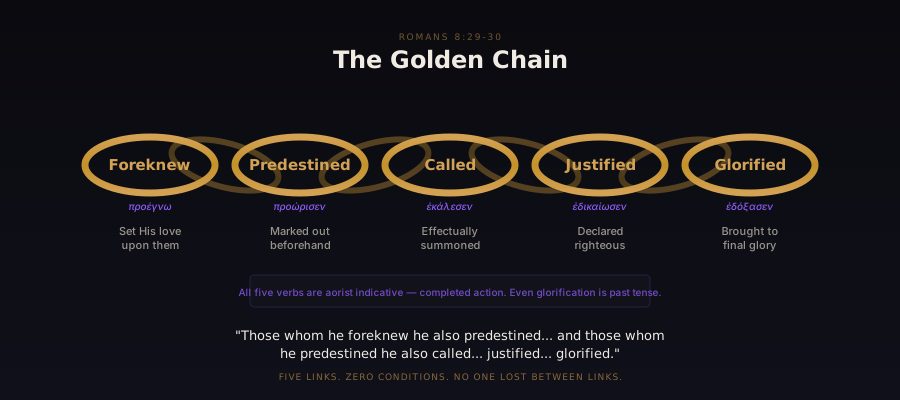
There is a question you have never said out loud, because saying it out loud would make you responsible for it. It is not a theological question — not yet. It is the quieter one underneath: What if I don't make it? What if there is a sin waiting in your future strong enough to break the thing that holds you? What if your faith thins, your grip loosens, and one morning the hand you thought was holding you is not there?
Paul knew you would ask. He wrote five words to answer you — five past-tense verbs that form a chain no force in the universe can break. And he arranged them in a Greek sentence whose grammar, once you see it, makes the fear you came here with grammatically impossible.
Five links. Five past-tense verbs. Zero dropouts.
The Chain Itself
Romans 8:28-30 is the foundation of eternal security. It describes a chain of five divine actions, each in the past tense, that links the elect from eternity to glory with zero dropouts. The chain is called "golden" because it is unbreakable. No one foreknown fails to be justified. No one justified fails to be glorified.
The passage is Paul's answer to the deepest assurance question: Can I fall away? Can I lose my salvation? Can I be separated from God? The answer Romans 8:28-30 gives is final. The chain has no broken links.
— Romans 8:28-30
The chain is gold because nothing in it is you.
Past tense. All of it. Even glorification. God speaks of your future glory as if it already happened — because in His mind, it did.
Notice the structure: foreknew → predestined → called → justified → glorified. Each arrow is one-directional. The passage does not say "some who are called are also justified." It says "those he called, he also justified." The group at each stage is identical. No one falls out. The chain is unbroken.
The One Word That Ends the Debate
All five verbs in this chain are aorist — a Greek tense for completed action. Foreknew, predestined, called, justified: past tense, fine. But then Paul writes ἐδόξασεν (edoxasen) — glorified. Past tense. For a glorification that has not yet happened to a single person you know, including yourself.
This is not a mistake. It is not a flourish. Paul had the full Greek verbal system available to him — the future tense, the subjunctive of certainty, the divine passive. He chose the aorist. He chose to describe your future glorification in a tense that declares it already done. What has not yet happened in time has already happened in the mind of God, and Paul reached past every tense of possibility to find the one tense that said completed. The future of the elect is already in the past with God. And the Holy Spirit, inspiring the Apostle, did not reach for a milder tense.
The implication is surgical. If glorification is already done in God's tense, then nothing between now and then can undo it. The chain is not an aspiration. It is a report of something that has already reached its final link — and looped back to the first. You live inside a completed sentence. You just have not yet arrived at the final word.
The Arguments
Romans 8:28-30 is a compressed syllogism. Each argument builds on the structure of the passage itself.
- All five verbs are aorist — past tense, treating the future as already accomplished.
- The same group appears at every stage: "those whom" — identical set, zero dropouts.
- Foreknowledge is relational choice (based on Amos 3:2, Gen 18:19), not mere prescience.
- Predestination marks the boundary beforehand — the destiny is predetermined.
- Calling is God's sovereign summons — those called are also justified.
- Justification and glorification are linked inseparably — no justified person fails to be glorified.
Pause. Notice what is happening inside you right now. If you are someone who has lived with the background hum of spiritual anxiety — the fear that tomorrow's sin might be the one that severs you — then part of you just read that chain and felt something you have not felt in a long time: relief. But another part of you is already fighting it. That part is saying: This can't be right. This is too secure. There must be a condition. There must be a way to fall out.
Daniel Kahneman called them System 1 and System 2 — the fast automatic mind that feels, and the slow deliberate mind that reasons. System 1 is the part of you that still panics you will not make it. System 2 is the part that reads Romans 8:30 and says but this is airtight, the chain has no gap. And here is the quiet tragedy of Christian assurance: most believers spend their entire lives with System 2 knowing they are saved and System 1 still panicking that they are not. You can prove eternal security on paper and still feel unsaved in the dark. The argument does not reach where the fear lives.
So read the chain again. Not to convince System 2 — System 2 is already persuaded. Read it slowly enough that System 1 sees what it has been refusing to see: there is no link in this chain made of you. The only reason to resist absolute security is the belief that your salvation depends, even one percent, on you. And if it depends on you — even one percent — then the chain has a link made of your willpower instead of God's decree. And willpower is not gold. It bends. It breaks. It is the very thing that has been failing you.
Objections Answered
The Verdict
The chain stands. Not a promise that God will try to keep us saved. Not a hope that we might make it to glory. A chain whose every link is forged by God — and the same people who are foreknown are the same people who will be glorified.
The verb tenses make this clear. Glorification is treated as already accomplished. The future is as certain as the past. God's perspective encompasses the entire span from eternity past to eternity future as a single, unified, unbroken chain.
This is why Paul can ask in verse 31: "If God is for us, who can be against us?" The answer is no one. Nothing can break the chain. No temptation can sever you from it. No sin can sever you from it. No external force can sever you from it. You are linked from foreknowledge through glorification. The chain is golden because it is unbreakable.
Stop on the fourth link, because it is the only one that cost anything. Foreknown, predestined, called — God does all three at no charge to Himself. Justified is not like that. To declare a guilty man innocent without ceasing to be just, God had to put the guilt somewhere, and He put it on His own Son: "he was pierced for our transgressions, he was crushed for our iniquities." The chain is unbreakable because one of its links is a body. That is what it is made of. That is why it holds.
And that is the ground of absolute assurance. You were foreknown by God before the creation of the world. You were predestined according to His purpose. You were called into faith. You were justified by His grace. And you will be glorified — not might be, will be. The chain has held from the beginning, and it will hold to the end. Your salvation was never a thread that depends on your grip. It is a chain of gold, and not one link was ever made of you: every link is held by the hand that made the universe — and that hand will not set it down.
Those hands have never opened.
Rest.