The Text
The biblical witness to compatibilism is woven throughout Scripture. Here are the core texts that establish both God's sovereign decree and human responsibility in the same act.
Acts 2:23 — The Crucifixion
Peter's first sermon establishes the pattern perfectly: the same event, two agents, two intentions, both real.
"This Jesus, delivered up according to the definite plan and foreknowledge of God, you crucified and killed by the hands of lawless men."
Acts 2:23 (ESV)
Notice the precision: Jesus was "delivered up according to the definite plan" (God's action) and you crucified him (human action). No "but" between them. No softening. Both are true, in the same verse, in the same act.
Genesis 50:20 — Joseph and His Brothers
The classical biblical illustration of compatibilism. Same action, two agents.
"As for you, you meant evil against me, but God meant it for good, to bring it about that many people should be kept alive, as they are today."
Genesis 50:20 (ESV)
The brothers' malice was real. Their intention was evil. Yet God's intention in the same act was good. Both agents acted according to their desires. Both were real. The same event served two purposes.
Philippians 2:12-13 — Work and Grace
The dual causation in sanctification: human effort and divine energy, in the same movement.
"Therefore, my beloved, as you have always obeyed, so now, not only as in my presence but much more in my absence, work out your own salvation with fear and trembling, for it is God who works in you, both to will and to work for his good pleasure."
Philippians 2:12-13 (ESV)
Paul does not say "Either work or wait for God." He says: Work (your agency) for God works in you (His agency). The same action flows from both sources. The causation is not divided—it is unified. God works in your work.
What Is Compatibilism?
Compatibilism is the theological and philosophical view that God's sovereign decree and genuine human agency are compatible—they can both be true without contradiction.
The Core Definition
Compatibilism affirms:
- God's sovereignty is absolute. He decrees all things that come to pass, including every choice, every action, every intention.
- Human agency is genuine. We truly choose. Our choices reflect our desires. We are morally responsible for our actions.
- These are not in tension. They do not require compromise. Scripture affirms both in the same sentence.
What Compatibilism Is Not
1. Not Hard Determinism
Hard determinism says: God decrees all things, therefore humans have no real choice and bear no responsibility. This view denies human agency.
But compatibilism affirms: God decrees all things AND humans have real choice AND humans bear real responsibility. The Reformed view is compatibilism, not hard determinism.
2. Not Libertarian Free Will
Libertarian free will says: For choices to be truly free, they must be undetermined—they must be independent of God's decree. This view denies God's sovereignty.
But compatibilism affirms: True freedom does not require independence from God's decree. Rather, freedom is the ability to act according to your own desires without external coercion. God can decree your desires and still call your action free.
3. Not Fatalism
Fatalism says: If the future is fixed, then means don't matter. Your choices are irrelevant because what will be, will be.
But compatibilism affirms: God ordains not only the end but also the means. Your choices are the means by which God accomplishes His purposes. Your decision to evangelize is the means by which God brings His elect to faith. Means matter infinitely.
The Reformed Definition of Freedom
In Reformed theology, freedom is not defined as "the absence of causation" but as "the absence of external coercion."
A person is free when they:
- Act according to their own desires
- Are not forced against those desires by external power
- Have the ability to do what they want
A prisoner in chains who wants to escape is not free—the chains prevent him. But a prisoner who doesn't want to escape is free in the deepest sense, even if he's locked in. His chains don't control him because his desires run along the path the chains allow.
God ordains our desires. But that ordination does not make us unfree; it makes us free to be ourselves.
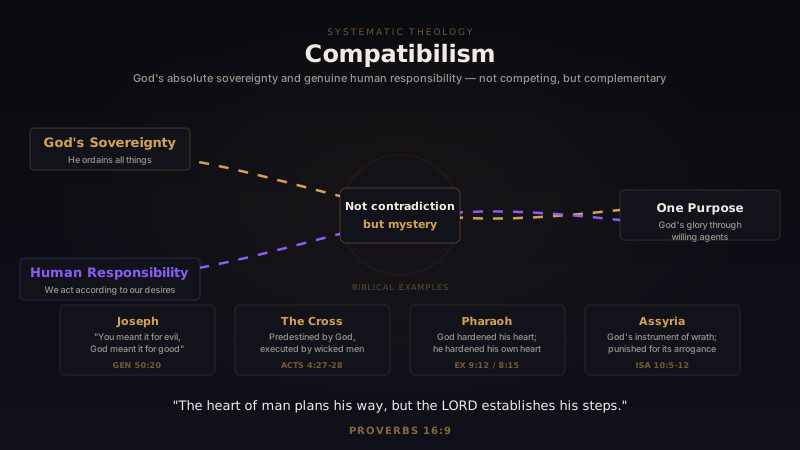
The Biblical Case — Scripture Models Compatibilism
The Bible does not present compatibilism as a philosophical puzzle to be solved. It simply affirms sovereign decree and human responsibility side by side, without apology.
Joseph and His Brothers
The setup: Brothers sin against Joseph out of malice. God providentially orchestrates the evil for good. Joseph is enslaved, imprisoned, elevated. Egypt is saved. The family is reconciled.
The compatibilist insight: The brothers' intention was evil (Genesis 50:20). Their choice was real. Their responsibility was real. But God's intention in the same act was good. God did not cause their sin by overriding their will. He ordained the evil by permitting it—and their evil intention served His good purpose.
As Joseph says: "You meant evil against me, but God meant it for good." Two intentions. One action. Both real. No contradiction.
The Cross of Christ
The setup: Jesus is crucified. Peter addresses the very people who crucified Him.
"This Jesus, delivered up according to the definite plan and foreknowledge of God, you crucified and killed by the hands of lawless men."
Acts 2:23 (ESV)
And later:
"For truly in this city there were gathered together against your holy servant Jesus, whom you anointed, both Herod and Pontius Pilate, along with the Gentiles and the peoples of Israel, to do whatever your hand and your plan had predestined to take place."
Acts 4:27-28 (ESV)
The compatibilist insight: The crucifiers were wicked men. Their intention was malicious—they wanted to destroy the threat Jesus posed to their power. Yet their action was "predestined by God's hand and plan." Their evil was freely chosen AND it was decreed by God. They are fully responsible. And God's hand was fully sovereign.
If you deny compatibilism, you must say either: (1) The cross was not decreed (making God helpless in history), or (2) The crucifiers were not responsible (making them mere puppets). Scripture refuses both options.
Pharaoh's Hardening
The setup: God tells Moses that Pharaoh will harden his heart. But God also says He will harden Pharaoh's heart. Both happen.
"But I will harden Pharaoh's heart, and though I multiply my signs and wonders in the land of Egypt, Pharaoh will not listen to you."
Exodus 4:21 (ESV)
Later:
"Then the LORD said to Moses, 'Pharaoh's heart is stubborn; he refuses to let the people go.'"
Exodus 7:14 (ESV)
And also:
"But Pharaoh hardened his heart this time also and would not let the people go."
Exodus 8:15 (ESV)
The compatibilist insight: God hardened Pharaoh's heart. Pharaoh hardened his own heart. The same obstinacy comes from both sources. God did not override Pharaoh's will; He ordained it. Pharaoh freely chose to resist. God orchestrated that free choice to demonstrate His power and mercy.
Assyria: God's Rod
The setup: God calls Assyria "the rod of my anger" and sends them to punish Israel. But then He judges Assyria for their arrogance.
"Woe to Assyria, the rod of my anger; the staff in their hands is my fury! Against a godless nation I send him, and against the people of my wrath I command him, to take spoil and seize plunder, and to tread them down like the mire of the streets. But he does not so intend, and his heart does not so think; but it is in his heart to destroy, and to cut off nations not a few."
Isaiah 10:5-7 (ESV)
Later:
"When the Lord has finished all his work on Mount Zion and on Jerusalem, he will punish the arrogant boasting of the king of Assyria and his haughty pride."
Isaiah 10:12 (ESV)
The compatibilist insight: Assyria does not know they are God's tool (Isaiah 10:7). They have their own intention: conquest and plunder. Yet they are the instrument of God's judgment. God sends them to punish Israel. They freely choose to invade. God will then punish them for that same choice. They are fully responsible and fully under God's decree.
Judas' Betrayal
The setup: Jesus predicts His betrayal by one of the Twelve. He knows it is Judas. He ordains it. Judas chooses it.
"For the Son of Man goes as it has been determined, but woe to that one by whom he is betrayed!"
Luke 22:22 (ESV)
And:
"Brothers, the Scripture had to be fulfilled, which the Holy Spirit spoke beforehand by the mouth of David concerning Judas, who became a guide to those who arrested Jesus."
Acts 1:16 (ESV)
The compatibilist insight: Judas' betrayal was "determined" by God. It had to be fulfilled. It was written in Scripture. Yet Judas is responsible. So responsible that Jesus pronounces woe upon him. The betrayal was simultaneously ordained by God and freely chosen by Judas out of his own greed and darkness.
The Babylonian Exile
The setup: God calls Nebuchadnezzar "my servant" and sends him to destroy Jerusalem. Then He judges Babylon.
"Now I have given all these lands into the hand of Nebuchadnezzar, the king of Babylon, my servant, and I have given him also the beasts of the field to serve him. All the nations shall serve him and his son and his grandson, until the time of his own land comes. Then many nations and great kings shall make him their slave."
Jeremiah 25:9, 25:12 (ESV)
The compatibilist insight: God orchestrates Nebuchadnezzar's conquest. Nebuchadnezzar conquers according to his own will and ambition. Both are true. God is so sovereign that He uses wicked kings as His instruments, yet holds them responsible for their wickedness.
Philippians 2:12-13 — Work and Grace
The setup: Paul commands the Philippians to work out their salvation. Then he reminds them that God works in them.
"Therefore, my beloved, as you have always obeyed, so now, not only as in my presence but much more in my absence, work out your own salvation with fear and trembling, for it is God who works in you, both to will and to work for his good pleasure."
Philippians 2:12-13 (ESV)
The compatibilist insight: You must work. God works in you. The same action flows from both your effort and His power. He does not work instead of you—He works in your work. Your responsibility to strive and His power to enable are not in competition. They are unified.
How Compatibilism Works — The Philosophical Framework
Compatibilism rests on a few key philosophical insights about the nature of the will, freedom, and causation.
The Nature of the Will
In Reformed theology (following Augustine and Edwards), the will is not an independent faculty that stands apart from the person. Rather, the will follows the strongest inclination of the person.
You cannot choose contrary to what you most desire. If you desire ice cream more than you desire the beach, you will choose ice cream. A person who loves righteousness will choose righteousness. A person who loves sin will choose sin.
Does this make the choice unfree? No. You are free when you do what you desire to do. The freedom is not in doing what you don't want, but in doing what you do want without being forced.
Now, God ordains your desires. That ordination does not violate your freedom; it establishes it. God gives the regenerate person a new heart that loves Christ (Ezekiel 36:26). That person now freely chooses what they previously could not: to love and obey God. The change in desire creates freedom.
Moral Inability vs. Natural Inability
Jonathan Edwards made this distinction crucial to compatibilism.
Natural inability: You cannot do something because you lack the physical or mental power. A person without eyes cannot see.
Moral inability: You cannot do something because your nature refuses it. A person who hates Christ cannot choose to love Him—not because they lack the ability to form thoughts or move their body, but because their heart is set against Him.
The unregenerate person has moral inability with respect to God. They can understand the gospel intellectually. They can move their body toward a church. But they cannot love God. Their nature—their settled inclinations—makes it morally impossible for them to choose righteousness.
This is why salvation requires regeneration. God must change the person's heart (moral transformation) so that they can freely choose what they previously could not: to love and trust Christ.
Compatibilism affirms: God overcomes moral inability without violating natural liberty. He transforms the heart so that the person freely does what they previously could not.
Freedom Is Not the Absence of Causation
The modern myth: freedom requires that your choice be uncaused—that nothing outside you determines what you do.
But this is logically incoherent. If your choice is not caused by your desires, your values, your knowledge, or your character, then what is it caused by? A random event? Then it's not your choice—it's chance. You don't become more free by making your choices random.
True freedom is not the absence of causation; it is the absence of coercion.
A person is free when their action flows from their own desires, nature, and volition—even if those desires are themselves caused by God's decree. God causing your desires does not make your action less free; it makes the action authentically yours.
God Ordains Through Secondary Causes
God does not typically accomplish His purposes by suspending human agency. Rather, He ordains that humans freely do what He decrees.
God ordains that you evangelize. You freely choose to evangelize because you love Christ. The free choice is the means by which God accomplishes the ordination. Your freedom and God's sovereignty are not in conflict—they are unified in the single act.
God could cause belief in a person by a direct act of will, overriding their mind. But instead, He ordains that your words become the means by which the Spirit creates faith. Your speech is a secondary cause through which God accomplishes His sovereign purpose.
This is why prayer matters. When you pray for God to change someone's heart, you are asking Him to ordain that change through secondary causes (your witness, circumstances, His Spirit's work). You are not asking Him to do something contrary to His sovereignty; you are asking Him to exercise His sovereignty in a particular way.
The Author and the Character
Consider a novel. The author determines every word the characters speak, every action they take, the outcome of every plot. The author's determination is absolute.
Yet the characters are not puppets. Within the world of the story, they act according to their nature, their desires, their intentions. A character's courageous choice is genuinely courageous even though the author determined it. The choice is real, the character owns it, and the author is responsible for orchestrating it.
This analogy has limits (God is not separate from His creation as an author is from a book), but it illuminates how God can determine all things while humans act freely from their own nature.
God is the Author of reality. You are a character in His story. Your actions are real. Your responsibility is real. Your character—your desires and nature—flow from His creative determination. The determination does not make your actions less real; it makes them truly yours.
The Greek and Hebrew
The original languages of Scripture use precise terms to express both God's decree and human agency. The words themselves resist any attempt to separate sovereignty from responsibility.
ὁρισμένῃ βουλῇ
hōrismenē boulē
"Determined counsel" / "Definite plan"
Acts 2:23: Jesus was delivered up "according to the definite plan and foreknowledge of God." God's decree is not vague or probabilistic—it is definite, determined, counsel. This is the strongest language for God's sovereignty.
ἐνεργέω
energeō
"To work," "to be active within"
Philippians 2:13: "It is God who works in you, both to will and to work." God does not work alongside you or instead of you. He works in you. The same action is energized by God's power and your own striving.
σκληρύνω
sklērunō
"To harden," "to strengthen"
Romans 9:18: "God hardens whom He wills." The term describes a strengthening in rebellion, a determination in refusal. God hardens by confirming the person in their chosen direction—not by overriding it.
ἔκδοτον
ekdoton
"Delivered up," "handed over"
Acts 2:23: Jesus was "delivered up" according to God's plan. The term suggests both active giving (by God) and human agency (the crucifiers' act). The same event is described as both delivered by God and delivered by human hands.
חָשַׁב
chashab
"To think," "to plan," "to devise"
Genesis 50:20: "You meant evil" / "God meant it for good." The same Hebrew verb describes both the brothers' intention and God's intention in the same act. The intent is real in both cases.
θέλημα
thelēma
"Will," "desire," "intention"
Philippians 2:13: God works in you "for His good pleasure" (the fulfillment of His will). Throughout Scripture, God's will is what He decrees and desires to accomplish. It is not opposed to human will; it is the source and perfection of it.
A Key Distinction: Decretive Will vs. Preceptive Will
Reformed theology distinguishes between two aspects of God's will:
- God's decretive will: What God has decreed will happen. This includes all sin and all good. This is what God will accomplish.
- God's preceptive will: What God commands. This is what God requires of us. We can violate God's preceptive will (break His commands), but we cannot violate His decretive will (accomplish contrary to what He has decreed).
Example: God decreed that Peter would deny Jesus three times (decretive will). God commanded Peter to confess Christ (preceptive will). Peter violated God's preceptive will (the command) but could not violate God's decretive will (the decree). His very violation of the command was ordained.
This distinction shows how God's decree includes human sin without commanding it or causing it in a way that violates human responsibility.
Critical Arguments
These arguments demonstrate why compatibilism is not merely biblical but logically necessary and practically essential.
1
The Cross Proves Compatibilism
If compatibilism is false, then the crucifixion poses an impossible dilemma:
- Option A: The cross was decreed by God. Then the crucifiers are not responsible (denying human agency).
- Option B: The crucifiers are responsible. Then the cross was not decreed by God (denying God's sovereignty).
But Scripture affirms both: "This Jesus, delivered up according to the definite plan of God, you crucified" (Acts 2:23). Peter holds the crucifiers responsible while affirming that the event was according to God's plan. If you deny compatibilism, you must say Scripture is incoherent here. But Scripture is not incoherent; your framework is inadequate.
2
Every Prayer Assumes Compatibilism
When you pray for God to change someone's heart, you are praying for God to do something impossible—unless compatibilism is true.
You are asking God to sovereignly determine a human decision. You are asking Him to ordain that someone freely repent. Your prayer assumes that God can accomplish His purposes through human volition, not in spite of it. That is compatibilism.
If libertarian free will were true, prayer for others' conversion would be pointless. You cannot ask God to control what is by definition uncontrollable. But we pray constantly for God to change hearts. Our practice refutes libertarianism and affirms compatibilism.
3
Libertarian Free Will Is Incoherent
Libertarian free will says a choice is free when it is undetermined—when nothing in the person determines what they choose.
But then what does determine the choice? If nothing—if it is random, arbitrary, causally disconnected from the person's character, desires, and nature—then it is not their choice. You are not more free by making your choices random. You are less your authentic self.
A free choice must flow from who you are: your desires, values, and nature. But your nature is what your desires are. If God does not determine your desires, then you are either not determined by anything (random) or determined by something outside yourself (alien).
Only if God determines your desires and you act according to those desires are you truly free and truly yourself.
4
Scripture Never Presents Sovereignty and Responsibility as a Tension
Modern readers import a tension into Scripture that is not there.
When Peter addresses the crucifiers, he does not say: "Now, theologically speaking, there's a tension here. On the one hand, God decreed this. On the other hand, you're responsible. Here's how we might reconcile these." He simply states both facts in the same verse: "You crucified Him according to God's plan."
When Paul commands the Philippians to work while reminding them that God works in them, he does not apologize for the paradox. He affirms both realities as unified in the Christian life.
The biblical authors are not struggling with a logical problem that later theology must solve. They are simply testifying to what is true: God is sovereign and we are responsible. Both, simultaneously, without qualification.
5
Compatibilism Alone Preserves Both Sovereignty and Dignity
Every alternative view sacrifices something essential:
- Hard determinism: Affirms God's sovereignty but sacrifices human dignity. We are not truly responsible.
- Libertarian free will: Affirms human dignity but sacrifices God's sovereignty. He cannot guarantee the accomplishment of His purposes.
- Compatibilism: Affirms both. God is sovereign. We are responsible. Our dignity flows from God's decree, not from independence from it.
There is no other view that preserves both truths. This is why compatibilism is not merely Reformed doctrine—it is the only coherent account of how God and creation relate.
Objections & Answers
Here are the most common objections to compatibilism and the Reformed responses.
Objection 1
"If God determines everything, how can He hold us responsible?"
Answer: Responsibility is based on the nature of the act and the nature of the agent, not on libertarian freedom.
Consider: A dog bites a child. The bite flows from the dog's nature—its aggression, its teeth, its instinct. The bite was determined by the dog's nature, not undetermined. Yet we judge the dog to be dangerous. We consider it a bad dog. Why? Because the bite reflects the dog's nature.
Similarly, sin reflects the sinner's nature. When a person sins, the sin flows from their corrupt desires, their rebellious heart. God decreed that the person would sin because He knew the person's nature. The person is responsible because the sin is authentically theirs—it flows from who they are.
Responsibility does not require that your action be undetermined. It requires that your action flow from your own nature and desires. And it does.
Objection 2
"Isn't this just fatalism with extra steps?"
Answer: No. Fatalism says means don't matter. Compatibilism says God ordains means as well as ends.
Fatalism: "What will be will be, so why do anything?" The future is fixed, and my effort cannot change it.
Compatibilism: "What will be will be through my effort. God has decreed the end. God has also decreed the means—my prayer, my evangelism, my diligence. My effort is not opposed to God's decree; it is the instrument through which God accomplishes the decree."
In fatalism, means are illusions. In compatibilism, means are essential. God uses causes. Your choice, your effort, your witness—these are the secondary causes through which the eternal decree is accomplished. They matter infinitely.
Objection 3
"If our choices are determined, how is God not the author of sin?"
Answer: God decrees that sin occurs through creaturely agency. The creature sins willingly from their own corrupt nature. The stain belongs to the instrument, not to the one who permitted its use.
The Westminster Confession (3.1) says: "God from all eternity did by the most wise and holy counsel of His own will, freely and unchangeably ordain whatsoever comes to pass; yet so as thereby neither is God the author of sin, nor is violence offered to the will of the creatures, nor is the liberty or contingency of second causes taken away, but rather established."
How? God ordains the sin through the secondary cause (the sinner's own corruption). God decrees the event but not the moral character of the event. The sinner originates the moral evil. God orchestrates the event for a good purpose.
Consider: A surgeon permits an assistant to use a scalpel, knowing the assistant is clumsy. The assistant's hand slips and damages the organ. Did the surgeon intend the damage? No. Did the surgeon foresee it and permit it? Yes. Is the damage the assistant's doing? Yes. Is the damage a perversion of the surgery's purpose? Yes. Yet the surgery's overall outcome serves good, even though this moment serves evil.
God does not intend sin in the way sin itself intends. God intends to permit sin and to accomplish good through it. The sinner intends sin for its own sake. The moral evil belongs to the sinner.
Objection 4
"Doesn't the Bible command us to choose? How is that compatible with determinism?"
Answer: Yes! Commands prove responsibility, not libertarian freedom. And commands are one of the means by which God ordains outcomes.
Joshua 24:15: "Choose this day whom you will serve." God commands choice. But choice does not require libertarian freedom. It requires that you genuinely decide according to your desires.
When God commands you to choose, He is:
- Calling you to take responsibility for your decision
- Speaking to you as a moral agent
- Using the command as the means by which He ordains the choice
God does not say "Choose, and be assured that I have not decreed what you choose." He says "Choose, and know that I will give you a new heart so that you choose well" (Deuteronomy 30:6; Ezekiel 36:26-27).
The command is compatible with decree because the command is the means through which the decree is accomplished.
Objection 5
"Can compatibilism explain hell?"
Answer: Yes. Those in hell are there because they willingly rejected God. Their rejection was certain by decree, but it was genuine and voluntary.
John 3:19: "This is the judgment: the light has come into the world, and people loved the darkness rather than the light because their deeds were evil."
The reprobate are not in hell because God's decree overrode their will. They are in hell because they chose darkness. Their choice was real. It was their own. And God foreknew it and decreed it.
Does this seem unjust? Consider: God has not decreed that anyone must sin. He has decreed that the sinner, left to their own corrupted nature, will freely sin. The decree accommodates the creature's nature; it does not violate it.
And God has provided a way of escape: the gospel of Christ. God offers salvation to all who will receive it (John 3:16; Romans 10:9). Those who reject it are rejecting the light. Their condemnation is just because they willingly choose it.
The difficulty we feel is not in compatibilism but in the depth of human fallenness. We do not like to accept that sinners love darkness. But that is the testimony of Scripture and of experience.
The Witnesses
Compatibilism is not a novelty. The greatest Christian thinkers have affirmed this doctrine and defended it against every objection.
Augustine of Hippo
On Grace and Free Will — Established that grace and free will are compatible. God's grace moves the will; the will responds freely. Laid the foundation for all Reformed compatibilism.
John Calvin
Institutes of the Christian Religion, Book 2.4 — Systematically defended divine sovereignty and human responsibility. Argued that God's decree ordains all things through secondary causes, not by bypassing them.
Jonathan Edwards
Freedom of the Will — The fullest philosophical defense of compatibilism. Refuted libertarian free will as incoherent. Established the distinction between moral and natural inability.
Westminster Assembly
Westminster Confession of Faith (3.1, 5.2) — Officially codified compatibilism in the confessional tradition. Affirms both God's absolute decree and the liberty of secondary causes.
Francis Turretin
Institutes of Elenctic Theology — Provided detailed theological and philosophical argumentation for compatibilism. Refuted every major objection.
D.A. Carson
Divine Sovereignty and Human Responsibility — Contemporary exposition showing how compatibilism is sustained throughout Scripture, particularly in prayer, election, and human choice.
John Frame
Doctrine of God — Shows how compatibilism flows from the doctrine of God's perfection. God's control and human responsibility are not in tension but in harmony.
John Piper
Providence and Prayer, Desiring God — Modern articulation of how compatibilism affects the Christian life. Prayer, evangelism, and sanctification all assume it.
Connections — Related Doctrines
Compatibilism is not an isolated doctrine. It connects to and depends on other central truths of Reformed theology.
Divine Decrees
God's eternal counsel and purpose. Compatibilism shows how the decree and human choice cohere.
Election
God's choice of His people. Election and human faith are compatible when compatibilism is understood.
Romans 9
Paul's treatment of God's sovereignty in salvation. The chapter assumes compatibilism throughout.
Free Will
What freedom means. Compatibilism redefines freedom as the absence of coercion, not undetermined choice.
The Golden Chain
The unbreakable sequence: foreknowledge, predestination, calling, justification, glorification. Compatibilism explains how each link holds.
Further Reading
Go deeper into compatibilism through these foundational and contemporary resources.
Foundational Works
- Jonathan Edwards, Freedom of the Will — The definitive philosophical treatment. Dense but rewarding. Edwards definitively refutes libertarian free will and establishes compatibilism.
- Francis Turretin, Institutes of Elenctic Theology (Vol. 1, Topics 8-10) — Technical and thorough. Shows how compatibilism fits within a complete theological system.
- Westminster Confession of Faith (Chapter 3, Sections 1-2; Chapter 5, Sections 2-4) — Brief but precise. The confessional summary of compatibilism.
- John Calvin, Institutes of the Christian Religion (Book 2.4; Book 3.24) — Clear and accessible. Calvin's own exposition of how sovereignty and responsibility relate.
Modern Expositions
- D.A. Carson, Divine Sovereignty and Human Responsibility — Indispensable. Shows compatibilism woven throughout Scripture. Essential reading.
- John Frame, Doctrine of God — Systematic and comprehensive. Places compatibilism within the doctrine of God itself.
- John Piper, Desiring God (Chapters 3-4) — Accessible and practical. Shows how compatibilism affects how you live and pray.
- John Piper, Providence: God's Providence in God's Hands — Contemporary and deeply biblical. Shows the comfort and strength that flow from compatibilism.
Philosophical Defenses
- Thomas Schreiner, Run to Win: The Lifelong Pursuits of a Godly Man (Chapter 2) — Contemporary philosophical defense with pastoral application.
- Paul Helm, The Providence of God — Philosophical and biblical. Shows how compatibilism avoids fatalism while preserving God's sovereignty.
- Sinclair Ferguson, Faithful God: An Exposition of the Attributes of God — Shows how God's attributes (omniscience, omnipotence) require compatibilism.
Specific Questions
- On human responsibility: John Murray, Redemption Accomplished and Applied (Part 2, Chapter 2) — How responsibility flows from God's decree.
- On prayer: D.A. Carson, Praying with Paul — How compatibilism makes prayer meaningful and urgent.
- On evangelism: A.W. Pink, The Sovereignty of God (Chapter 8) — How compatibilism motivates evangelism rather than hindering it.
- On hell: John Piper, The Legacy of Sovereign Joy (Part 3) — How compatibilism addresses the problem of divine justice in condemnation.