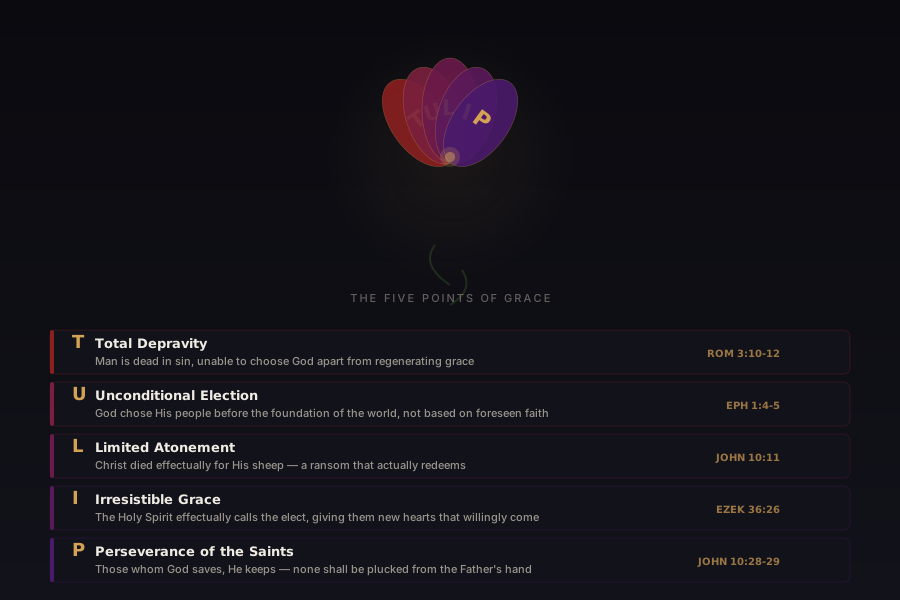
Before we begin, understand this: TULIP is not the gospel. It is a framework for understanding the gospel. The gospel is that God saves sinners through Christ. TULIP explains how He does it — and the answer is breathtaking in its thoroughness.
Each petal of the TULIP answers a question. Click each one below to explore it.
The Question: How bad off are we?
"Total depravity" doesn't mean every person is as evil as possible. It means that every part of every person is affected by sin — mind, will, affections, desires. No part is untouched. The result? We are not merely sick and in need of medicine. We are dead and in need of resurrection.
A dead man cannot choose to come alive. He cannot reach out his hand. He cannot cooperate with the doctor. He needs someone to raise him from the dead. That "someone" is God.
Why this matters: If we are dead in sin, then salvation cannot begin with us. It must begin with God. This is the foundation on which every other point stands.
Go deeper: Dead, Not Sick →The Question: How does God decide who is saved?
If all humanity is dead in sin, and no one seeks God, then how does anyone get saved? The Bible's answer: God chooses them. Not because of anything He foresees in them — not their faith, their goodness, or their potential. He chooses them purely because of His own purpose and grace.
Notice: He didn't choose us because we would be holy. He chose us that we should be holy. Holiness is the result of election, not the cause.
Why this matters: Election means your salvation was planned before you existed. It doesn't depend on you getting it right. It depends on God being faithful to His own purpose.
Go deeper: Chosen Before the Foundation of the World →The Question: For whom did Christ die?
This is perhaps the most misunderstood of the five points. A better name would be definite atonement or particular redemption. The question is not whether Christ's death is sufficient for all — it is. The question is: what did Christ actually accomplish on the cross?
Did He merely make salvation possible for everyone? Or did He actually secure salvation for His people?
Notice: He will save His people — not "try to save" or "make it possible for." Christ's death accomplishes exactly what it was designed to accomplish: the certain redemption of everyone the Father gave Him.
Why this matters: If Christ died for you, you will be saved — not might be, not hopefully, but certainly. His sacrifice is not wasted on anyone for whom it was intended.
Go deeper: My Sheep Hear My Voice →The Question: Can God's grace be defeated?
"Irresistible grace" doesn't mean people can't resist God at all — they do, constantly. It means that when God purposes to save someone, He effectually overcomes their resistance. He doesn't drag unwilling people kicking and screaming. He changes their hearts so that they come freely, joyfully, willingly — because He has made them new.
Count the "I wills" in that passage. Who is doing the work? God. He gives the new heart. He removes the stone. He puts His Spirit within. He causes obedience.
Why this matters: You didn't outsmart sin. You didn't have more willpower than your unbelieving neighbor. God opened your eyes. If you believe, it's because grace made you willing.
Go deeper: A New Heart →The Question: Can a true believer lose their salvation?
The short answer: no. But not because of our grip on God — because of His grip on us. A better name for this doctrine might be the preservation of the saints, because it's God who does the preserving.
If God chose you before the foundation of the world (election), sent His Son to die for you specifically (atonement), and sent His Spirit to bring you to life (grace) — do you really think He'll let you slip through His fingers at the end?
Why this matters: You can have real, unshakable assurance. Not because your faith is strong, but because your God is faithful. The chain that began in eternity past (Romans 8:29–30) ends in glory — and not a single link can break.
Go deeper: Sealed by the Spirit →The Logic of Grace
Notice how each point flows into the next like links in a chain:
Because we are totally depraved, God must choose us (unconditional election). Because He chose us, Christ died specifically for us (definite atonement). Because Christ secured our redemption, the Spirit effectually applies it (irresistible grace). And because God began the work, He completes it (perseverance).
Remove any one point and the whole chain falls apart. But kept together, they reveal a God whose grace is complete, coherent, and unstoppable.
That's the golden chain of redemption. No one falls between the links. Everyone who is foreknown is glorified. The numbers match at every stage.
Reflection Questions
- Which petal of TULIP do you find most compelling? Which one do you find most difficult? Why?
- How does the "logic of grace" — each point flowing into the next — change how you see the coherence of the Bible's teaching on salvation?
- If every point of TULIP is true, what does that mean for your assurance right now, today?
- Read Romans 8:29–30 slowly. Can you find a single person who starts the chain but doesn't finish it?